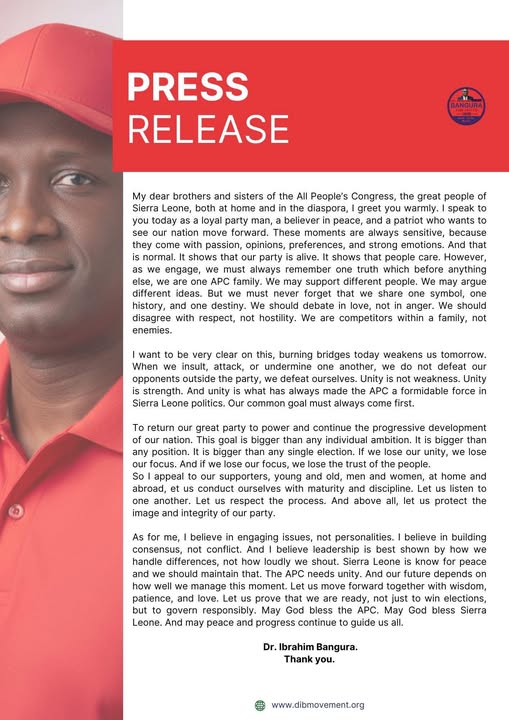


Dr. Ibrahim Bangura has issued a carefully calibrated but deeply consequential intervention into the internal dynamics of the All People’s Congress (APC), using a unifying press release to caution party members against internal excesses that could ultimately weaken their collective chances of returning to power. Though couched in the language of peace, family, and shared destiny, the statement carries unmistakable political weight, reflecting both the urgency of the moment and the risks facing the party if internal divisions are allowed to deepen.
Addressing APC members and Sierra Leoneans at home and in the diaspora, Bangura presented himself first as a loyal party man and patriot concerned about national progress. He openly acknowledged that the current political climate within the APC is emotionally charged, marked by strong opinions, preferences, and passions. Rather than condemning this intensity, he framed it as evidence of a living, breathing party whose members care deeply about its future. In doing so, he validated internal engagement while simultaneously warning that passion, if left unchecked, can easily slide into conduct that damages both the party’s image and its long-term cohesion.


Central to Bangura’s message is the idea that the APC, despite its internal debates and rivalries, remains one family. By emphasizing shared symbols, history, and destiny, he reminded members that internal competition must never erase collective identity. His insistence that disagreements should be conducted with respect rather than hostility signals growing concern that political rivalries within the party may be crossing from healthy debate into open antagonism. In a party with a long tradition of intense internal contests, this warning resonates as both timely and deliberate.
Perhaps the most politically charged element of the statement is Bangura’s caution against what he described as “burning bridges.” In APC terms, this is a direct warning against scorched-earth politics, public insults, factional warfare, and personal attacks that may deliver short-term advantage but leave long-lasting scars. Bangura was explicit in his assessment that such behavior does not weaken external opponents but instead turns the party against itself. By framing internal conflict as self-defeat, he challenged members to reconsider tactics that prioritize personal victory over collective survival.
Bangura’s repeated emphasis on unity as strength rather than weakness is particularly significant in a political environment where aggression and dominance are often mistaken for leadership. His framing redefines political maturity as restraint, patience, and the ability to manage differences constructively. In effect, he advanced a vision of leadership rooted not in noise or confrontation, but in discipline and consensus-building, qualities he implied are essential for any party seeking not just to win elections but to govern responsibly.
The press release also carried a subtle but firm rebuke to unchecked ambition. Bangura reminded members that the APC’s overriding mission is to return to power and deliver progressive development for Sierra Leone, a goal he described as larger than any individual, position, or single election. This assertion serves as both a warning and a recalibration, signaling that personal aspirations must ultimately be subordinate to party unity and national interest. In doing so, Bangura placed the party’s credibility with the electorate at the center of the conversation, warning that internal disarray risks eroding public trust.
By calling on supporters across generations and across borders to conduct themselves with maturity and discipline, Bangura widened responsibility beyond party leadership. His appeal suggests an awareness that internal discord does not remain confined to closed meetings but increasingly plays out in public spaces, shaping voter perception and media narratives. His emphasis on respecting processes further underscores the importance of legitimacy, transparency, and fairness at a time when the APC’s internal decisions are under heightened scrutiny.
Bangura’s personal leadership philosophy, as outlined in the statement, reinforces his broader political positioning. His declaration that he believes in engaging issues rather than personalities and in building consensus rather than conflict situates him as a stabilizing voice amid turbulence. By asserting that leadership is best demonstrated by how differences are managed rather than how loudly one speaks, he implicitly critiques divisive political styles that thrive on confrontation and spectacle.
Importantly, Bangura linked internal party conduct to Sierra Leone’s national identity as a peaceful country. This connection elevates the stakes of internal APC behavior beyond partisan politics, framing it as a matter of national responsibility. His call to move forward with wisdom, patience, and love reflects a broader appeal to political culture, urging restraint at a time when polarization threatens not only party unity but democratic stability.
In closing, Bangura’s message reads as both a warning and a roadmap. It cautions that unchecked internal battles could derail the APC’s ambitions and weaken its ability to reclaim power, while also outlining the values, unity, discipline, respect, and collective purpose that he believes must guide the party through this critical moment. As the APC approaches decisive internal milestones, the press release stands as a defining intervention, one that challenges members to choose between fragmentation and focus, between personal rivalry and shared destiny. Whether the party heeds this call may well determine not only its electoral fortunes but its capacity to govern if power is regained.
Sourced: SPARE NEWS