
By Albert David
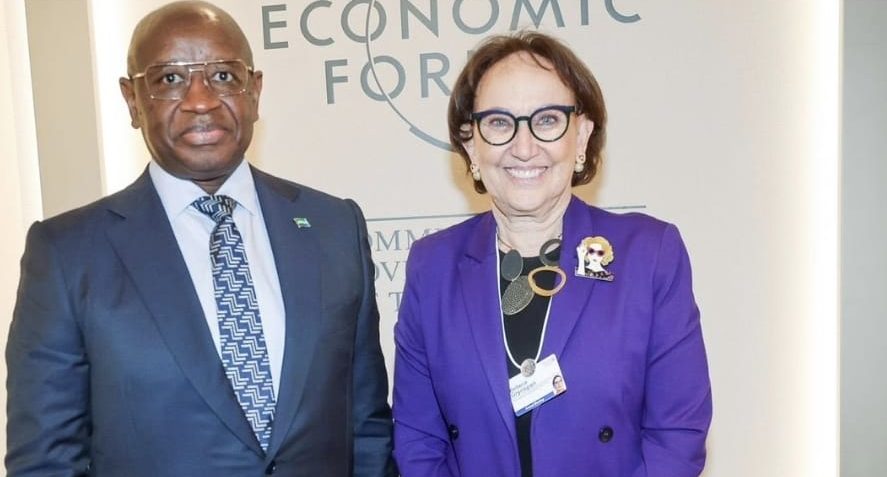
Sierra Leone’s presence at the 2026 World Economic Forum in Davos marked more than a diplomatic appearance, it signaled a country intent on redefining its economic identity. President Julius Maada Bio’s announcement that Sierra Leone is the first African nation to complete and gazette its National AfCFTA Readiness Assessment and Schedule of Commitments is, by any objective measure, a significant achievement. It positions the country as a continental frontrunner in trade preparedness and regulatory modernization.


Yet, as with every major national milestone, celebration must be paired with scrutiny, and optimism must be matched with sober analysis. The AfCFTA offers unprecedented opportunity, but only if Sierra Leone’s leadership, institutions, and private sector align around the genuine interests of the people.
President Bio’s framing of Sierra Leone’s AfCFTA readiness as a product of resilience, emerging from civil war, Ebola, and global economic shocks, reflects a narrative of national recovery and institutional strengthening. Completing the Readiness Assessment is not a symbolic gesture, it is a technical, data-driven process that many larger economies have struggled to finalize.
This achievement signals three important realities. (1) Sierra Leone is capable of meeting complex continental standards. (2) The country is willing to embrace transparency in trade policy. (3) There is a strategic intention to attract investment through regulatory clarity. These are not small feats for a developing economy.
The President’s emphasis on digital transformation is both timely and essential. Paper-based systems have long slowed Sierra Leone’s trade processes, increased corruption risks, and discouraged investors.
The shift toward (a) digital customs platforms , (b) harmonized regulations, (c) reduced transaction costs and (d) Small and Medium-sized Enterprises SME-friendly digital infrastructure, is not merely modernization, it is economic survival in a continental market increasingly driven by speed, data, and interoperability.
The challenge now is execution. Digital reforms must be insulated from political interference, supported by skilled personnel, and accessible to small businesses, not just large corporations.
President Bio’s commitment to value addition rather than raw commodity export aligns with global best practice. Special Economic Zones, industrial parks, and skills development are all necessary pillars of industrial growth. However, Sierra Leone must confront hard questions.
(a) Will Special Economic Zones SEZs be governed transparently and free from elite capture?, (b) Can the country ensure reliable electricity, water, and logistics, without which industrialization collapses?, (c) Will skills development reach rural youth, not only urban centers?, and (d) Can agribusiness value chains be built without land conflicts or environmental degradation?. Industrialization is not achieved by policy declarations alone, it requires disciplined implementation and long-term institutional stability.
The President’s insistence that the private sector must drive AfCFTA trade is economically sound. No country grows through government action alone. The Readiness Assessment as a “transparent prospectus” for investors is a promising approach, but transparency must be continuous, not episodic.
For Sierra Leoneans to benefit, the government must ensure the following.
(a) fair competition that prevents monopolies,
(b) access to trade finance for local entrepreneurs,
(c) clear, and predictable regulations,
(d) anti-corruption safeguards in investment approvals, and
(e) support for women- and youth-led businesses.
This is because a thriving private sector cannot be built on selective access or political favouritism.
Sierra Leone’s AfCFTA readiness positions the country as a model for the continent, but models are judged by outcomes, not announcements. To ensure this milestone translates into real prosperity, Sierra Leone must.
(1). Build institutions stronger than political cycles and Trade reforms must survive changes in leadership.
(2). Prioritize local businesses, not only foreign investors, also foreign capital is welcome, but domestic entrepreneurs must not be sidelined.
(3). Invest in human capital at scale, this is also because a modern economy requires a skilled, healthy, and empowered workforce.
(4). Strengthen accountability mechanisms, every reform must be monitored, audited, and publicly reported.
(5). Ensure that growth is inclusive, economic expansion must reach the farmer in Kailahun, the trader in Makeni, the fisherman in Tombo, and the youth innovator in Freetown.
President Bio’s message in Davos was clear. Sierra Leone is open for business. The country has a roadmap, a regulatory framework, and a vision aligned with continental integration. But the world will judge Sierra Leone not by its readiness documents, but by the ease of doing business, the reliability of its institutions, the transparency of its governance, the competitiveness of its workforce and also the stability of its macroeconomic environment. If these pillars hold, Sierra Leone can indeed transform from a nation of potential into a nation of performance.
Supporting the President’s AfCFTA achievement is not partisan, it is patriotic. But patriotism also demands vigilance. Sierra Leone’s economic future depends on leadership that is bold yet accountable, ambitious yet grounded, visionary yet practical. The AfCFTA milestone is a door.
Whether Sierra Leone walks through it with discipline, integrity, and national unity will determine the well-being of generations to come.