

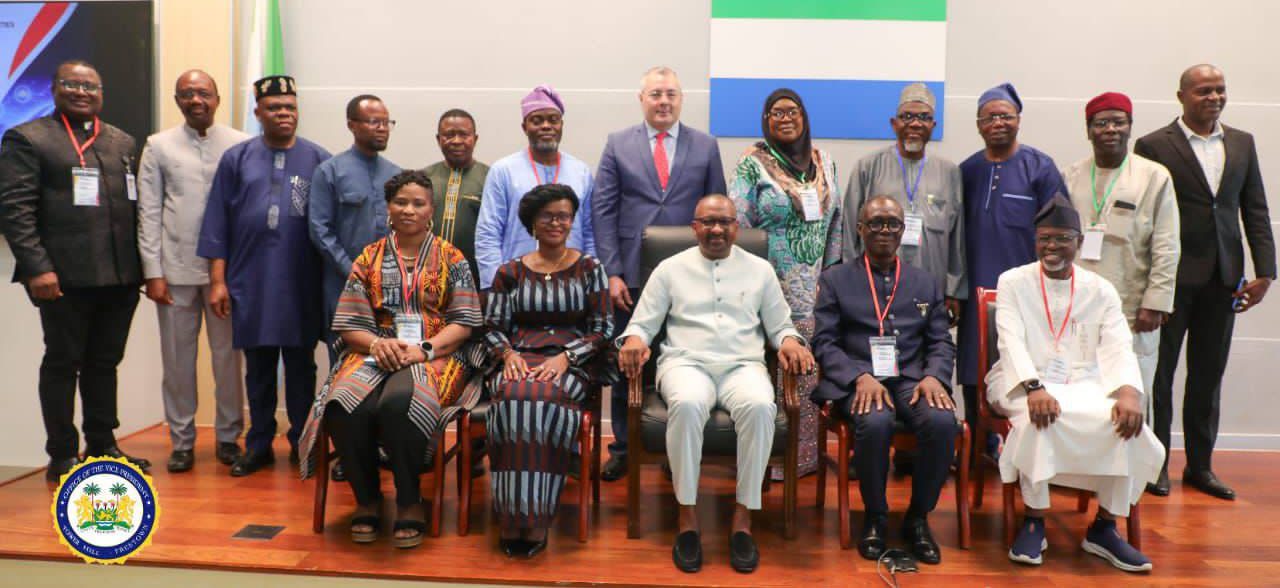
Freetown, February 21, 2026 (SLENA)-Vice President Dr. Mohamed Juldeh Jalloh has challenged West African universities to reclaim their role as engines of regional integration and intellectual renewal. Delivering the closing address at the 11th Annual Conference and 13th Annual General Meeting of the Association of West African Universities (AWAU), he called for a collective shift toward harmonized curricula, academic mobility, and research collaboration.
Speaking before an audience of professors, policymakers, and scholars at the Foreign Academy, the Vice President framed this year’s theme “Bridging Innovation with Quality Assurance in West Africa” within a broader historical arc. He recalled the golden decades of the 1960s and 1970s, when West African universities stood as vibrant centers of intellectual excellence and symbols of post-independence promise.
However, he acknowledged the institutional decline of the 1980s and 1990s, when funding dried up and research output suffered under mounting teaching pressures. Yet, despite these challenges, the Vice President praised the resilience of individual academics who preserved the spirit of scholarship. “The university survived,” he emphasized, “because professors kept the flame alive, often with support from international foundations.”


Looking ahead, VP Jalloh urged AWAU to function as a catalyst for what he described as “regional integration from below.” He called on universities to align academic standards, promote cross-border student and faculty mobility, and build collaborative research networks capable of addressing shared regional challenges.
“The university of tomorrow must be established now,” he declared, stressing that innovation and cooperation are no longer optional but imperative particularly as global development financing tightens and democratic pressures intensify across parts of the region.
In her remarks, the Minister of Technical and Higher Education, Dr. Haja Ramatulai Wurrie, commended the Vice President for his steadfast commitment to advancing education. She noted that under President Julius Maada Bio’s leadership, education has remained a national priority from the flagship Free Quality School Education program (2018–2023) to ongoing development strategies for 2023–2028.
The Minister emphasized that platforms like the AWAU conference are vital for fostering quality assurance, knowledge exchange, and access to continental resources. She expressed deep appreciation for the Vice President’s role in championing higher education reforms and cross-border academic collaboration.
The conference concluded on an inspiring note, with delegates energized to reposition their institutions as drivers of integration, innovation, and sustainable development. The collective message was clear: West Africa’s universities must not only respond to change they must lead it.
Correspondent-Aminata Turay
Office of the Vice President