

By Albert David
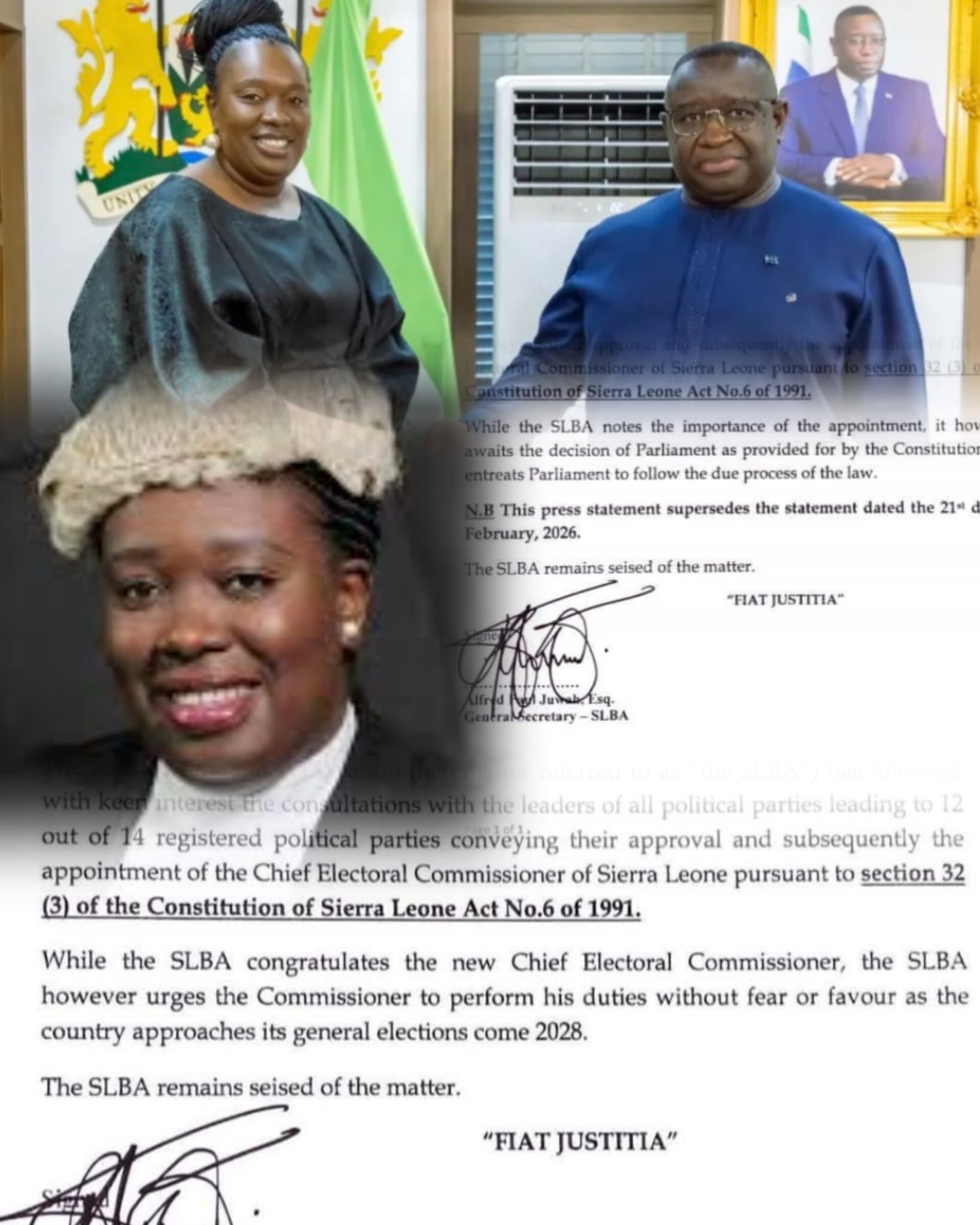
The withdrawal of the Sierra Leone Bar Association’s congratulatory message is a welcome correction, but it does not erase the deeper constitutional, ethical, and institutional questions their initial action has raised. If anything, the retraction underscores the seriousness of the misstep. It confirms that the concerns raised by citizens, legal minds, and civic commentators were not only valid but necessary.


In a constitutional democracy, the rule of law is not a suggestion. It is the bedrock upon which public trust, institutional legitimacy, and democratic stability rest. Section 32(3) of Sierra Leone’s Constitution is explicit: the appointment of the Chief Electoral Commissioner is incomplete without parliamentary approval. This is not a symbolic ritual. It is a constitutional checkpoint designed to prevent unilateralism, safeguard independence, and ensure that no branch of government, executive or otherwise, can predetermine the leadership of an institution as consequential as the Electoral Commission.
Against this backdrop, the Bar Association’s premature endorsement was not merely an error of timing. It was a disturbing lapse in constitutional judgment, an ethically questionable act that risked projecting complicity in undermining due process. When the professional body entrusted with defending the Constitution appears to validate an appointment before the constitutional process is complete, it sends a troubling message: that legality can be bypassed, that parliamentary oversight is secondary, and that institutional independence is negotiable. Such a posture is not only unprofessional, it is democratically corrosive.
The Bar Association’s leadership is expected to embody neutrality, constitutional fidelity, and professional independence. When its public actions appear aligned with political enthusiasm rather than legal discipline, the credibility of the institution suffers. The optics of issuing a congratulatory message before parliamentary approval, especially from a leadership already under scrutiny for perceived political proximity, undermines public confidence in the Association’s impartiality. Legal institutions derive their authority from ethical distance, not political closeness. Their legitimacy depends on their willingness to uphold constitutional order even when doing so is inconvenient or unpopular. Anything less weakens the moral authority of the legal profession.
The Bar Association’s decision to withdraw its premature endorsement is a step in the right direction. It demonstrates responsiveness to public concern and a recognition, however belated of constitutional boundaries. But the withdrawal does not erase the initial breach. Instead, it highlights the need for deeper introspection: How did such a statement pass internal scrutiny?. What does this say about the Association’s internal governance and ethical compass?. How can the Bar rebuild public trust after appearing to validate a process that was constitutionally incomplete?. These questions are not rhetorical. They go to the heart of institutional accountability.
The Bar Association must confront the implications of its actions. A legal body cannot afford to be perceived as politically entangled or constitutionally inattentive. Its mandate is to defend the rule of law, not to echo executive enthusiasm or pre‑empt parliamentary authority. This moment demands a reaffirmation of constitutional discipline, a recommitment to professional independence, a transparent review of internal decision‑making processes, and a clear demonstration that the Association stands above partisan influence. Anything less risks further erosion of public trust.
The Sierra Leone Lawyers’ Society demonstrated the constitutional clarity and ethical courage expected of a legal institution. It reminded the nation that democracy cannot be built on shortcuts, that legality is not optional, and that constitutional processes must be respected in full. The Bar Association must now rise to that standard, not through statements alone, but through consistent, principled action.
The Constitution is the supreme law of the land. Its authority cannot be diluted by haste, enthusiasm, or institutional complacency. The Bar Association’s premature endorsement was a deviation from its constitutional duty. Its withdrawal is a corrective step, but also a reminder of the vigilance required to safeguard democratic integrity. Sierra Leone deserves legal institutions that embody constitutional fidelity, ethical independence, and professional courage. This moment is an opportunity for the Bar Association to reclaim that role, not through rhetoric, but through renewed commitment to the principles that define the legal profession.