

By Kemo Cham
On December 16, Sierra Leone is expected to declare its Mpox epidemic over, ending nearly 12 months of health emergency.
The emergency was declared in early January, as the world grappled with what would become the largest global Mpox outbreak in history.


Mpox is a zoonotic disease that causes fever, headache, and painful skin lesions. It spreads through close physical contact, either from infected animals to humans or from person to person. The virus has demonstrated new characteristics in the current global outbreak, including changes in transmission patterns and symptoms. These shifts have challenged traditional containment strategies.
Despite Sierra Leone’s experience dealing with emergencies and a few cases of Mpox in previous years, this epidemic proved overwhelming for it.
“Sierra Leone has a history of dealing with outbreaks, but this was new,” says Prof. Foday Sahr, Executive Director of the National Public Health Agency (NPHA). “This was the first huge outbreak (of Mpox).”
Mpox was first identified in 1958 in laboratory monkeys in Denmark, and human cases have been documented since 1970 in the Democratic Republic of Congo (DRC). The most recent and widespread outbreak began in May 2022, after a case was reported in the United Kingdom. It spread to over 120 countries. That marked the first time the virus was detected in significant numbers outside endemic regions.
On July 23rd, 2022, WHO declared the outbreak a Public Health Emergency of International Concern (PHEIC). Ten months later, the emergency was declared over, after over 100, 000 confirmed cases and over 200 deaths.
But cases continued in smaller numbers, until an outbreak of a new strain was declared in DRC in September 2023. On August 13th, 2024, the Africa Centers for Disease Control and Prevention (Africa CDC) declared the first ever Public Health Emergency of Continental Security (PHECS) after cases escalated across the continent. WHO followed suit the following day by declaring a PHEIC for the second time within two years.
By this time, all three of Sierra Leone’s Mano River Union neighburs – Guinea, Liberia and Cote d’Ivoire – had already experienced cases of the virus. Sensing the high risk of an outbreak in the country, NPHA and the Health Ministry instituted measures to prevent escalation if it eventually enters. And on January 10th, 2025, the bad news came. Two cases had been detected in the Western Area Rural.
At this point, DRC, Burundi and Uganda were the most affected by the virus on the continent. By May, at the peak of the continental outbreak, Sierra Leone had confirmed close to 2,000 active cases, with every one of its 16 districts now affected. The strain in transmission in the country proved more virulent than was expected, resulting in a rare form of genital lesions in patients. Genome sequencing confirmed the virus was mutating.
Dr Joseph Sam Kanu, Programme Manager for Surveillance and Applied Epidemiology at NPHA, recalls his first experience visiting a treatment center and how that changed his perception.
“I had no idea about the magnitude of the problem, and you wouldn’t know how much you needed to act to end the outbreak,” he says.
With just two cases in the second week of January, Sierra Leone registered over 5,000 cases in six months, becoming the main driver of cases on the continent.
“That was alarming and very worrying to all of us, including our partners,” says Prof. Sahr.
With the help of these partners, notably the UN family, Africa CDC and the West African Health Organization (WAHO), the country re-strategized. UNFPA’s involvement was crucial in ensuring that reproductive health services remained uninterrupted despite the strain on the healthcare system.
Initially, the response focused on the Western Area. But cases were now increasing in the other districts. A major constraint was delay in funding to implement NPHA’s strategies at the initial stage.
“When we started, we knew what to do and we knew how to do it. But the biggest challenge was resources,” says Dr Kanu. This was the primary reason for the home base treatment policy, which was blamed for escalation of cases in the communities.
“The surveillance programme, for instance, was able to detect cases, but one of the challenges was the movement of samples. Also, once the results came back, we had challenge of where to admit the patients,” Kanu explains.
The 34 Military Hospital (34MH) was the first place to admit Mpox patients. Dr Captain Adama Kamara had the unenviable task of dealing with between 50 and 60 daily admissions, with only 13 available beds.
“Almost 70 percent of them were in critical condition. I had to make the decision on who gets a bed and who doesn’t,” says Kamara, who’s Clinical Lead at the hospital’s Infectious Diseases Center.
The NPHA and its partners eventually established over 700 hundred beds country wide, starting with 56 at 34MH.
For Dr Saiku Tejan, Medical Superintendent at the Port Loko Regional Hospital, the epidemic has been his most challenging professional mission so far. He was in medical school when Sierra Leone battled Ebola. But not even his volunteer experience then prepared him for this.
“I was worried because, firstly even though we had experienced emergency – Ebola – that had been a long time and most of the staff with that experience were no longer around. I feared that those available were inexperienced,” he says. Another concern for him was that as a referral hospital, patients come from everywhere and directly access the facility, posing risk of infection to both staff and other patients.
Port Loko became one of the top four most affected districts, recording 217 confirmed cases when the national countdown started. The experience of Dr Tejan and his team exemplifies the dedication of health workers nationwide to efforts to contain the virus. One of his most memorable stories is that of a pregnant woman brought in with “classic symptoms” of Mpox – extensive genital lesions. The team’s priority was to deliver her safely without infecting the baby.
“The patient didn’t have any indication for caesarean section, so I suggested we observe maximum IPC, place her far from the other women in the labor room,” Dr Tejan recounts.
Luckily, he notes, on that day they had only two other women in labour. Still, they had to divide the staff into two, so that those who attended to the suspected case didn’t interfere with the other cases.
“We delivered the suspect with a bouncing baby girl…and we never got any word that the baby got ill,” he says.
Another challenge Sierra Leone’s Mpox response faced in its early days was low laboratory testing capability. Port Loko relied on other districts to test its samples. As a nation, this especially impacted advanced testing capability, like viral sequencing. WHO recommends for at least 8 percent of samples in a country to be sequenced during emergencies. However, with only two laboratories with this capacity at the start of the epidemic, Sierra Leone could only sequence 1.7 percent of samples locally.
Through collaboration with the Institute Pasteur de Dakar, one of two mobile laboratories deployed in the country was hosted in Port Loko. The other one was installed in Kabala, Koinadugu District. That increased the country’s Mpox testing capability, including for viral sequencing, to eight.
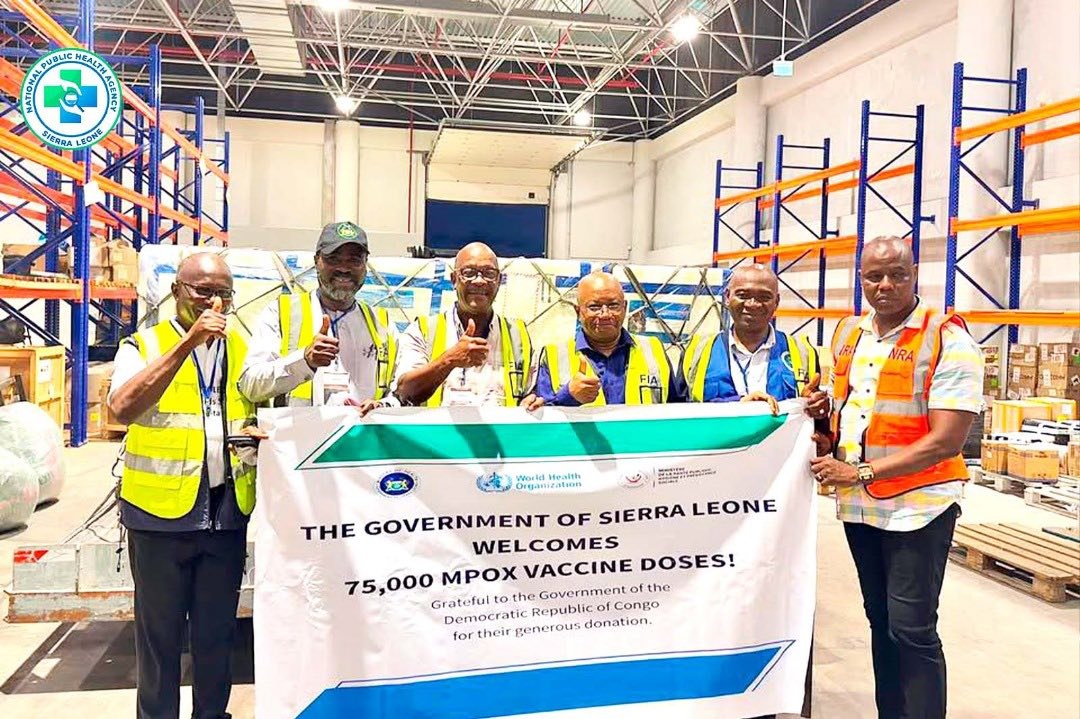
To break the chain of transmission required heightened community engagement nationwide. This was achieved through ‘Operation Find Them All, which saw health workers brave some of the most inhospitable parts of the country to raise awareness, embark on surveillance and contact tracing. The resources were also expended to improve treatment, care and Infection Prevention Control (IPC) measures. The government used all available diplomatic means to mobilize vaccines, amidst a very limited global stock. Sierra Leone received a total supply of 267,000 doses of vaccines by the end of its vaccination campaign, all at no cost, thanks to the generous support of partners like the U.S, Africa CDC, Gavi, WHO, and UNICEF. About 200, 000 people were vaccinated by the end of October.
The response also had to deal with mis and disinformation on and offline, which fueled stigma and consequently preventing many people from seeking early treatment.
Mathew Fomba Sam nursed infections for over two months before finally summoning courage to seek medical attention. On the advice of his spiritual leader, he consumed nearly a dozen sachets of Pega Pack, a locally brewed high concentration alcoholic drink rumoured to treat Mpox. His condition only worsened. Sam says his fears were driven by rumors of bad experience of patients in treatment centers.
“I thought of how people died in previous outbreaks,” he says.
Sam’s love relationship suffered due to stigma. But he doesn’t regret coming out to seek treatment early.
“In the beginning, people didn’t fully accept that it was Mpox,” says Captain Kamara, who had patients questioning medication she administered on them.
“The messages were going round that government just had hidden agenda, not until the public started seeing cases depicting the severity of the disease…”
Reports suggest widespread stigma in communities driven by a perception that people who contracted Mpox were sexually promiscuous, because of the symptomatic display of genital lesion in many patients.
This situation called for intense community engagement and public sensitization. The government, says Prof. Sahr, made use of every available resources and engaged every stakeholder.
“When we started initially, we had challenge of late availability of resources. But eventually government came in handy and provided the much needed resources,” he says.
From being the lead in transmission of Mpox cases on the continent, Sierra Leone’s response became a lesson for others. The Africa CDC hosted Health Minister Dr Austin Demby on its weekly press briefing to share Sierra Leone’s experience turning the tide on Mpox. He summed it up to local ownership and collaboration.
“It’s a testament to country ownership, country leadership in creating (…) partnership with government leaders, with traditional leaders, with civil society, with our development partners and our technical partners, especially Africa CDC,” he says.
This report was done with support from UNFPA, through NPHA – SL.