
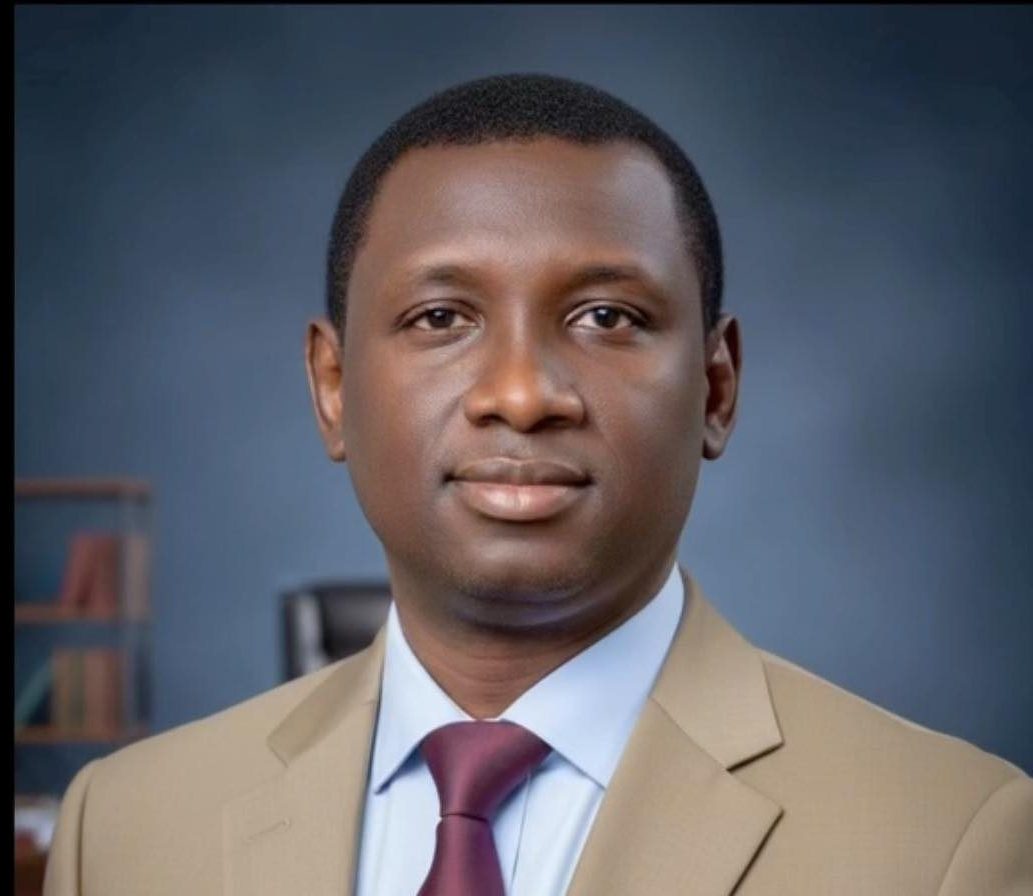
In the ever-revolving theatre of Sierra Leonean politics, where rhetorical exuberance frequently masquerades as visionary leadership, the emergence of Ibrahim Bangura compels a more exacting interrogation. Is he merely another addition to the already saturated pantheon of political aspirants, or does he embody a paradigmatic rupture from the calcified orthodoxies that have long enervated the state?
This is not a trivial inquiry. It is, rather, a question freighted with historical consequence.


For decades, the All People’s Congress, like many political institutions across postcolonial Africa, has oscillated between charismatic populism and entrenched patronage, often at the expense of technocratic competence and institutional fortification. The consequences of such oscillations are neither abstract nor academic; they are etched into the lived realities of citizens and indelibly inscribed in the nation’s collective memory, particularly in the traumatic aftermath of the Sierra Leone Civil War.
Against this backdrop, Dr Bangura’s candidacy—implicit or emergent—must be situated within a broader dialectic between continuity and transformation. He is not, by conventional metrics, the archetypal political gladiator. His pedigree is not forged in the crucible of partisan theatrics, nor is his ascent lubricated by the familiar instruments of patron-client reciprocity. Instead, his intellectual formation has been shaped within the austere, and often unforgiving, domains of academia and policy praxis, with affiliations extending to globally venerated institutions such as the University of Oxford.
To dismiss such a profile as politically anodyne would be a categorical misreading. On the contrary, it is precisely this deviation from the norm that renders him a figure of latent, perhaps even disruptive, significance.
Dr Bangura’s scholarly engagements in peacebuilding, governance architectures, and post-conflict reconstruction are not merely ornamental credentials; they constitute a substantive epistemic arsenal. In a polity where governance deficits are frequently symptomatic of deeper structural infirmities, the possession of such analytical acuity is not a luxury but an imperative. He represents, in this sense, a technocratic counterpoint to the prevailing culture of improvisational governance.
Yet, it would be intellectually disingenuous to romanticize his prospects without a sober acknowledgment of the formidable impediments that lie ahead. Sierra Leonean politics, like many of its counterparts within the subregion, is not merely a contest of ideas but a labyrinthine arena defined by entrenched loyalties, informal power networks, and the often opaque calculus of political survival. In such an environment, intellectual gravitas does not automatically translate into electoral viability.
And herein lies the paradox.
For the APC, the consideration of Dr Bangura as a potential standard bearer is not merely a question of candidate selection; it is an existential referendum on the party’s future trajectory. Does it persist in the well-trodden pathways of political expediency, or does it venture, perhaps audaciously, into the less certain terrain of intellectualized leadership?
The answer to this question will reverberate far beyond party confines. It will signal, to both domestic constituencies and the international community, whether Sierra Leone is prepared to recalibrate its governance ethos in favour of competence, coherence, and long-term statecraft.
Central to Dr Bangura’s emergent political philosophy is the tripartite injunction: Heal, Unite, Build.
At first glance, this triadic formulation may appear deceptively simple, almost aphoristic. Yet, upon closer scrutiny, it reveals a layered and profoundly resonant framework for national renewal.
To heal is to confront, with unflinching candour, the residual fissures that continue to fragment the social fabric. It is an acknowledgment that the legacies of conflict, exclusion, and institutional fragility cannot be wished away through platitudes.
To unite is to transcend the parochial cleavages—ethnic, regional, and partisan—that have historically circumscribed the nation’s political imagination. It is an appeal to a higher, more inclusive conception of citizenship.
To build is to pivot from discursivity to delivery; to transition from the performative dimensions of politics to the painstaking, and often prosaic, work of institutional construction and economic transformation.
These are not merely rhetorical flourishes. They are, or ought to be, the foundational pillars of any serious governance agenda in a state still navigating the complexities of post-conflict consolidation.
For the political elites of Sierra Leone—and indeed for discerning observers across the global policy landscape—the question is therefore stark.
Is Dr Ibrahim Bangura an anomaly to be sidelined, or an inflection point to be embraced?
To answer in the negative, to retreat into the comfort of familiar political archetypes, is to risk perpetuating a cycle of underperformance that the nation can ill afford. To answer in the affirmative, however, is to undertake a calculated, perhaps even audacious, wager on the transformative potential of ideas, intellect, and principled leadership.
History suggests that such wagers are seldom without risk. But it also teaches that the most consequential moments in a nation’s trajectory are often precipitated by the willingness to depart from the ordinary.
Sierra Leone now stands before such a moment.
The choice, as ever, resides not in the abstract, but in the deliberations of those who wield influence within the All People’s Congress and beyond.
Another politician, or a statesman in waiting?
The distinction may well define the next chapter of the republic.