
An extraordinary story of survival and international medical cooperation is unfolding in Sierra Leone, where a Guinean patient has made a remarkable recovery after years of unsuccessful treatment attempts across multiple countries.
Mohamed Bal, a 56-year-old man from Guinea, arrived in Freetown in a critical condition, seeking specialized care from the 27th Batch Chinese Medical Team stationed at the China-Sierra Leone Friendship Hospital. His journey was driven by desperation after enduring four years of undiagnosed and worsening heart failure that had left him soaked in sweat, gasping for air, and suffering from severe abdominal bloating and vomiting, unable to walk or even lie flat.
According to medical staff, Bal’s condition had deteriorated significantly despite consultations at several hospitals. With limited options remaining, he learned about the presence of Chinese cardiac specialists and a China-aided Cardiac Care Unit (CCU) in Sierra Leone. Determined to survive, he made the difficult decision to travel, overcoming a major language barrier as he speaks only French.


Upon his arrival at the hospital, doctors immediately recognized the severity of his condition. His blood pressure was recorded at a dangerously low 74/50 mmHg, while his ejection fraction (EF)—a key measure of heart function—stood at just 30 percent, indicating severe cardiac impairment.
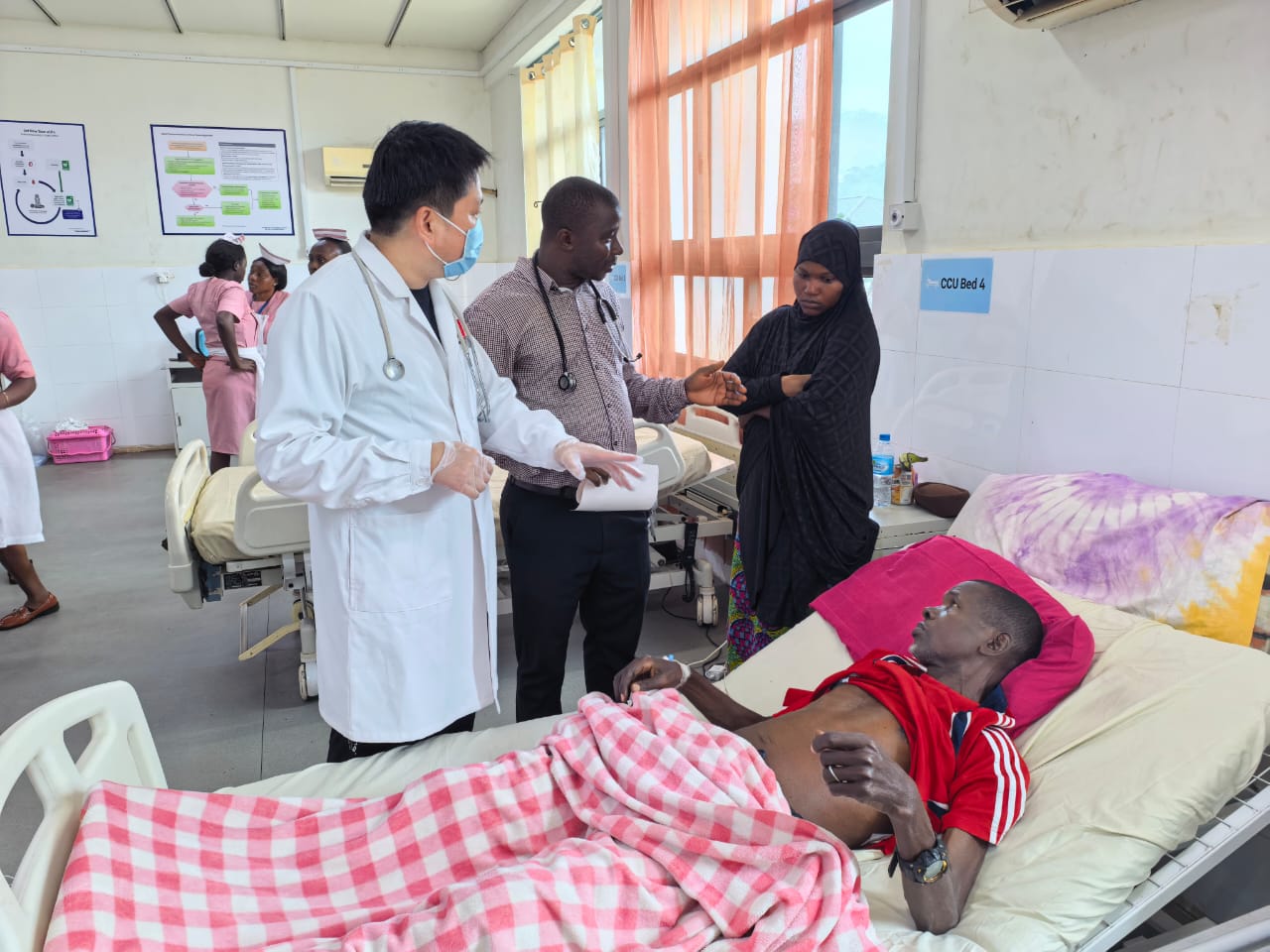
The medical team, led by Professor Sheng Jie, swiftly conducted a detailed physical examination, identifying critical signs such as jugular venous distention and systemic edema. With support from ultrasound specialist Zhou Cheng, they then performed comprehensive diagnostic assessments. Within a short period, they identified the root cause of his illness as mitral stenosis combined with dilated cardiomyopathy, a complex and life-threatening combination that had previously gone undetected.
With an accurate diagnosis in place, the team initiated an intensive treatment plan within the CCU. Over the course of his care, Bal responded positively to the interventions, showing steady and significant improvement. Medical personnel report that he has now regained mobility and can perform normal daily activities—an outcome that once seemed impossible.
Hospital officials confirmed that Bal is expected to be discharged on Saturday, marking a major milestone in his recovery journey. His case has been widely described by healthcare professionals as a testament to the effectiveness of timely diagnosis, advanced medical expertise, and coordinated care.
Speaking through interpreters, Bal expressed deep gratitude to the Chinese medical team for saving his life. He gave a thumbs-up to Professor Sheng and uttered a heartfelt “Thank you” in halting English. He revealed plans to return for follow-up care, even if it requires traveling back from his home in Guinea, demonstrating his deep trust in the treatment he received.
Medical observers say the case highlights the growing importance of international collaboration in addressing complex health challenges in Africa. The presence of the Chinese medical team—backed by the expert resources of Central South University Xiangya Hospital—and the establishment of the China-aided CCU have significantly expanded access to specialized healthcare services not only for Sierra Leoneans but also for patients across the region.
The intervention also underscores the role of medical diplomacy in strengthening ties between nations. By providing critical healthcare services and transferring knowledge to local practitioners, such partnerships contribute to long-term improvements in healthcare delivery systems.
For Sierra Leone, the successful treatment of Mohamed Bal reinforces the country’s emerging reputation as a destination for specialized medical care in West Africa, attracting patients from neighboring Guinea, Liberia, Gambia, and Ghana. It also reflects the broader impact of sustained cooperation between China and Sierra Leone in the health sector.
As Bal prepares to leave the hospital, his recovery stands as a powerful symbol of hope—one that demonstrates how borders can be bridged through compassion, expertise, and a shared commitment to saving lives