
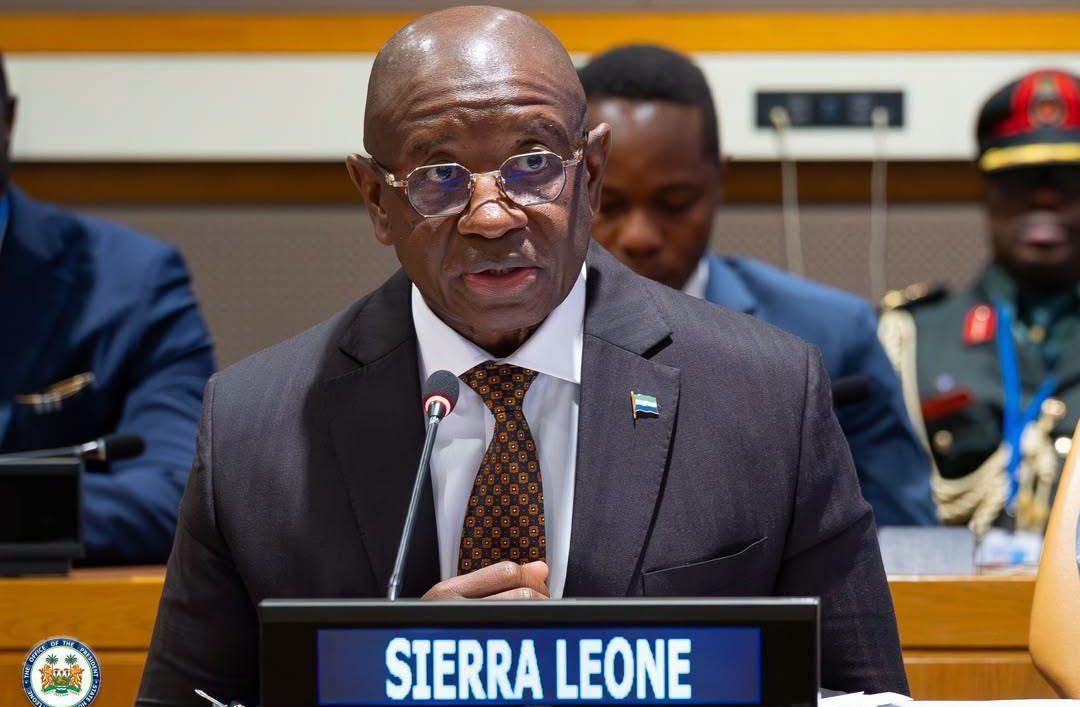
New York, Thursday, 24 September 2026- His Excellency President Julius Maada Bio has outlined five principles he says must underpin the g7+ Framework for Peace through Dialogue and Reconciliation, calling for its formal endorsement, prompt implementation and clear accountability to transform the framework from an aspiration into a practical instrument for preventing conflict and sustaining peace.
Speaking as an Eminent Person of the g7+ at a High-Level Summit on the margins of the 81st Session of the United Nations General Assembly in New York, President Bio identified national ownership, prevention, practical action, adequate resources and coordinated global advocacy as essential to making the framework effective.
President Bio said the framework must first be founded on consent, trust and national ownership. It should be activated only at the invitation of the concerned member state and remain voluntary, confidential and complementary to existing regional and international efforts.


He said the distinctive value of the g7+ should come from the shared experience of countries that have confronted conflict and recovery, with member states working to “listen, accompany and share experience” rather than dictate solutions.
On prevention, President Bio called for a fundamental shift in the way the international community responds to conflict, arguing that action should begin before tensions become crises.
“The measure of this framework should not be how many crises it responds to, but how many crises it helps to prevent,” he said.
He proposed that the Council of Eminent Persons become a standing and readily available resource capable of early, discreet and constructive engagement when invited by a member state, alongside a high-level meeting to establish a roadmap for preventive engagement, dialogue and reconciliation.
President Bio said the framework must also be practical and inclusive, providing for peer-accompaniment missions, structured knowledge exchange and targeted technical assistance among member states. He called for the strengthening and expansion of the Rapid Response Advisory Centre to help countries address legal, political and development risks before they escalate.
He further stressed that peacebuilding cannot be confined to governments and political leaders, insisting that women, young people and communities affected by conflict must have a meaningful place in peace processes.
“Sustainable peace is built not only around negotiating tables, but also in homes, communities, schools, institutions and places of worship,” President Bio said.
On resources, President Bio warned that a framework without the capacity to act would remain “no more than a communiqué.” He called on member states to equip the g7+ Secretariat with the financial and human resources required to fulfil its mandate and urged predictable and flexible financing under g7+ ownership.
He also called on international partners to invest more in prevention rather than concentrating support on emergency response after crises have already erupted.
“Investment in prevention is not charity. It is the most responsible and cost-effective investment the international community can make in collective peace and security,” he said.
The President’s fifth principle focused on stronger and more coordinated global advocacy by the g7+. He urged member states to speak with greater unity in global decision-making institutions, arguing that their experience of conflict, recovery and state-building should inform international decisions on political transitions, peacebuilding and development financing.
He said fragility should not be treated as a permanent identity or a condition to be indefinitely managed, but as a challenge to be overcome through national leadership, sustained partnership and patient institution-building.
President Bio subsequently called on the Summit to formally endorse the g7+ Framework for Peace through Dialogue and Reconciliation and mandate its prompt implementation, with clear responsibilities, adequate resources and accountability for results.
“That is how we move from declarations to delivery,” he said, stressing that countries once affected by conflict can become sources of knowledge, leadership and solutions.
Credit: State House Media and Communications Unit