
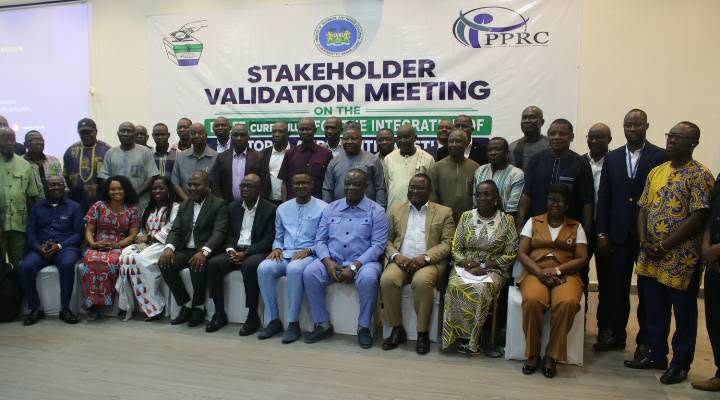
Freetown, September 22, 2026 ( SLENA)-Ministry of Technical and Higher Education (MTHE) participated in the Electoral Commission of Sierra Leone (ECSL) stakeholders’ validation session on the draft Electoral and Political Studies curriculum for university education, advancing Resolution 13 Tripartite Committee Report calling for electoral civic education institutionalisation in tertiary institutions.
Session held at Brookfields Hotel, Freetown, drawing high-level stakeholders: Deputy Minister, Technical Higher Education, Chief Electoral Commissioner, ECSL Commissioners, Political Parties Regulation Commission (PPRC), Tertiary Education Commission (TEC), Council Vice-Chancellors, Principals, university representatives, curriculum experts.
Electoral Commissioner North Abubakarr Koroma welcomed participants, noting the meeting marked the third consultation stage following June July 2026 engagements validating curriculum implementation.


Western Region Commissioner responsible for Oversight, Training Procedures, Zainab Umu Moseray, described the exercise as an important milestone in strengthening electoral democratic education, curriculum promoting knowledge, responsible participation, tolerance, inclusion, and national cohesion.
Chief Electoral Commissioner Edmond Alpha said the programme builds on ECSL’s earlier electoral education initiatives, including the Basic Electoral Administration Course introduced in 2006. The new university programme would develop professionals and informed citizens, encouraging practical learning through research, internships, and field engagement.
PPRC Chairman Emmanuel K. Amara Esq. said electoral political studies should integrate giving students a broader understanding of elections, political parties, participation, accountability, and democratic governance. He stressed tolerance, dialogue, and peaceful political competition.
TEC representative Josephus Sawyer reaffirmed TEC’s commitment to supporting accreditation implementation, programme equipping young people with knowledge and skills for responsible democratic participation.
Council Vice-Chancellors Principals Chairman Prof. Edwin J. Momoh commended the collaborative process, universities ready working stakeholders ensuring curriculum academically sound, relevant, and responsive to Sierra Leone’s needs.
Final draft curriculum presented outlining key areas: electoral administration, electoral justice, inclusion, ICT elections, election security, human rights, political parties, democratic governance, campaign financing, political ethics, media information integrity, peacebuilding, conflict resolution. Training of Trainers programme for university lecturers will precede implementation.
Deputy Minister of Technical Higher Education Sarjoh Aziz-Kamara commended the collaborative effort, emphasising strengthening electoral and political knowledge in higher education. He encouraged stakeholders to use the validation process to produce a practical, relevant, sustainable programme contributing to informed citizenship and democratic development.
The validation session concluded with stakeholders reaffirming their commitment to completing the validation, accreditation, and implementation processes for the Electoral Political Studies programme in Sierra Leone. New BSc Electoral Political Studies curriculum expected to be finalised integrated universities’ academic programmes for the 2026/27 academic year.
Credit: Correspondent-Richard Williams,Ministry of Technical and Higher Education