
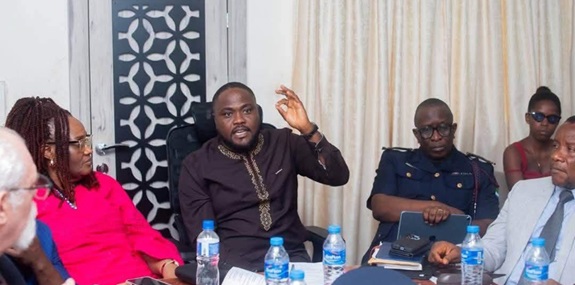
Mr Yankuba Askia Bio, Director General of the Sierra Leone Ports and Harbours Authority (SLPHA), has dismissed The Economist’s claim that containers were removed from the Port of Freetown after undergoing standard scanning procedures as “untrue”. Bio, speaking at a press conference in Freetown, said the report was “completely false and malicious” and suggested his involvement in incidents that occurred before he took office.
Bio based his answer on timing, saying he did not take on the director general role until October 2023. Parliamentary records confirm that timeline, showing Bio’s appointment was formally approved on October 24, 2023. The Economist asked him about linking him to activities that allegedly happened late in 2022.


Bio also disputed the article’s characterisations of port operations, noting the Port of Freetown only moved to 24-hour operations in 2026 following a sustained increase in cargo volume. The SLPHA figures presented at the briefing indicate that the current throughput is about 8,670 containers a month. Transit TEUs were 1,029 in 2023, 2,294 in 2024, and 3,286 in 2025, a 219 per cent increase between 2023 and 2025. Exports in full TEU increased from 12,661 in 2024 to 17,750 in 2025 (about 40%), while imports increased from 68,227 TEUs in 2023 to 75,619 in 2024 and 82,609 in 2025, with an average annual increase of about 11.3 per cent.
The growth narrative aligns with other recent reports and officials’ praise for the port’s modernisation. “The improvements are a product of the collaboration between SLPHA, government agencies and private operators,” Bio said, describing the port’s structural model: “Since 2011, the Port of Freetown has been a landlord-port, where the concession to carry out containerised cargo operations was awarded to Bolloré Logistics, now Freetown Terminal Limited. “The SLPHA is the infrastructure, the regulation, the safety, the coordination,” he said. “Private companies do the operation.”
Representatives at the briefing clarified responsibilities. Logistics Services Solutions is responsible for cargo tracking; Integrated Trade Services for scanning and quality inspections; Nectar Sierra Leone Bulk Terminal for non-containerised bulk and break-bulk cargo; stevedoring companies for vessel labour; and the Indigenous Transport Owners Association and private hauliers for quay haulage. Customs officials reminded them they were responsible for revenue collection and enforcing import and export rules.
Bio said new training, technology, and work with security agencies to improve intelligence and intercept illegal shipments have strengthened port security. He and port operators said no cocaine had been found at the port. The SLPHA said more than 1,400 cartons of tramadol and other counterfeit pharmaceuticals have been seized since January 2026. Police received th e items for analysis and destruction. The authority has also inducted 69 security personnel, who are undergoing professional training, and procured new patrol vehicles.
Bio closed the briefing by urging foreign journalists and international media to seek comment from Sierra Leonean institutions before publishing allegations, saying the SLPHA is open to scrutiny and asking them to cross-check information to avoid damaging portrayals of the country’s main international trade gateway.